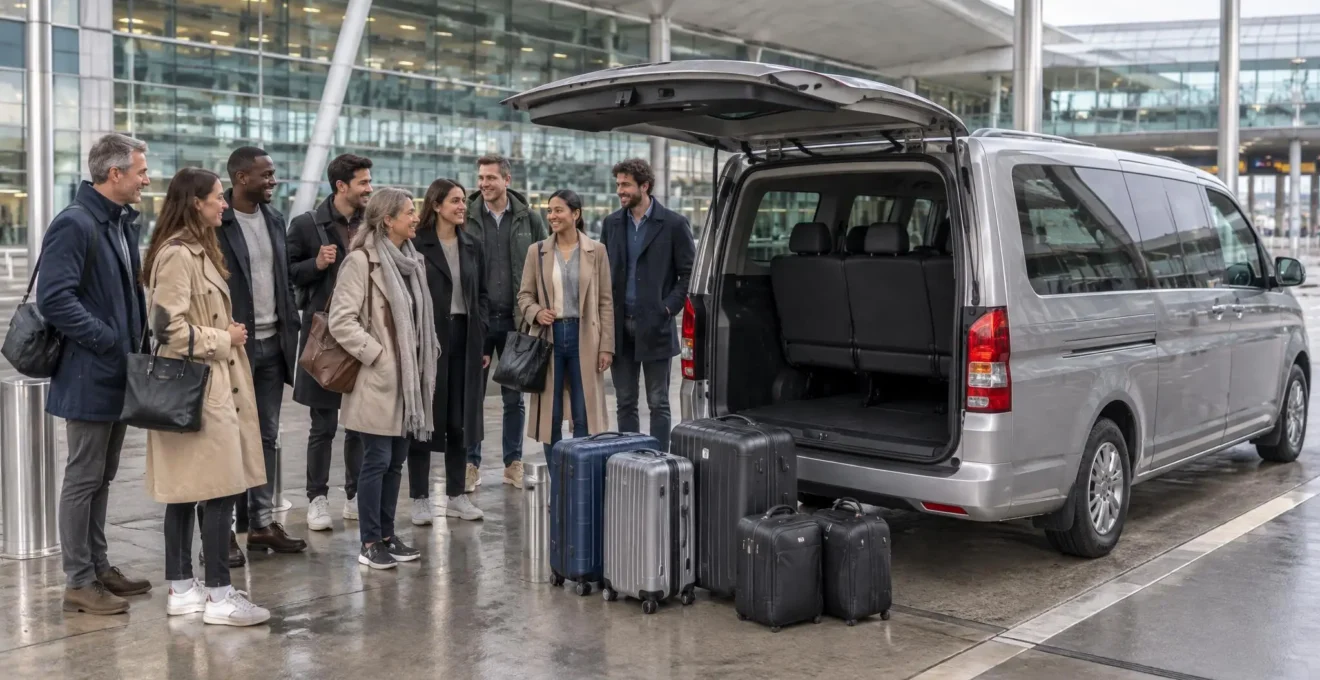
A nine-seat minibus can carry luggage with every passenger seat occupied, but the available space varies considerably between models. At Paris Charles de Gaulle Airport, the published fleet information lists some nine-seat vehicles with nine luggage units, while others offer six or a range of six to nine. These figures do not necessarily mean that nine large suitcases will fit. The decisive factors are the vehicle configuration, the dimensions of each bag and the storage space remaining behind the last row of seats.
How much luggage fits in a nine-seat minibus at Paris CDG?
The published fleet information provides a useful starting point for comparing configurations. Three listed models indicate nine luggage units, while the Mercedes Vito indicates six and the Minibus Classic gives a range of six to nine. These are the operator’s advertised luggage counts, not standardised measurements of suitcase capacity.
| Minibus model | Seat configuration | Advertised luggage units |
|---|---|---|
| Renault Trafic | 9 seats | 9 |
| Citroën Jumpy | 9 seats | 9 |
| Toyota Proace Verso | 9 seats | 9 |
| Mercedes Vito | 8/9 seats | 6 |
| Minibus Classic | 9 seats | 6–9 |
For a group with substantial luggage, the models advertised with nine luggage units are sensible candidates to examine first. The Mercedes Vito’s six-unit indication and the Minibus Classic’s six-to-nine range signal different or variable advertised allowances. This helps narrow the selection, but it is not a ranking of physical boot volumes: the figures alone cannot establish which vehicle will fit more large suitcases.
When a group of nine people, including the driver, is travelling from Paris CDG, choosing a vehicle involves more than checking its passenger capacity: the available luggage space must also match the group’s actual bags. The minibus hire at Paris Charles de Gaulle Airport service from WeVan lists several nine-seat configurations with different advertised luggage capacities, helping travellers identify the models they should examine before confirming their suitcase requirements.
An indication of nine luggage units is not a guarantee that nine bulky checked suitcases will fit. Use the advertised figures for initial selection, then check the dimensions of the actual bags against the storage space available in the vehicle being reserved.
Why luggage space changes between nine-seat minibus models
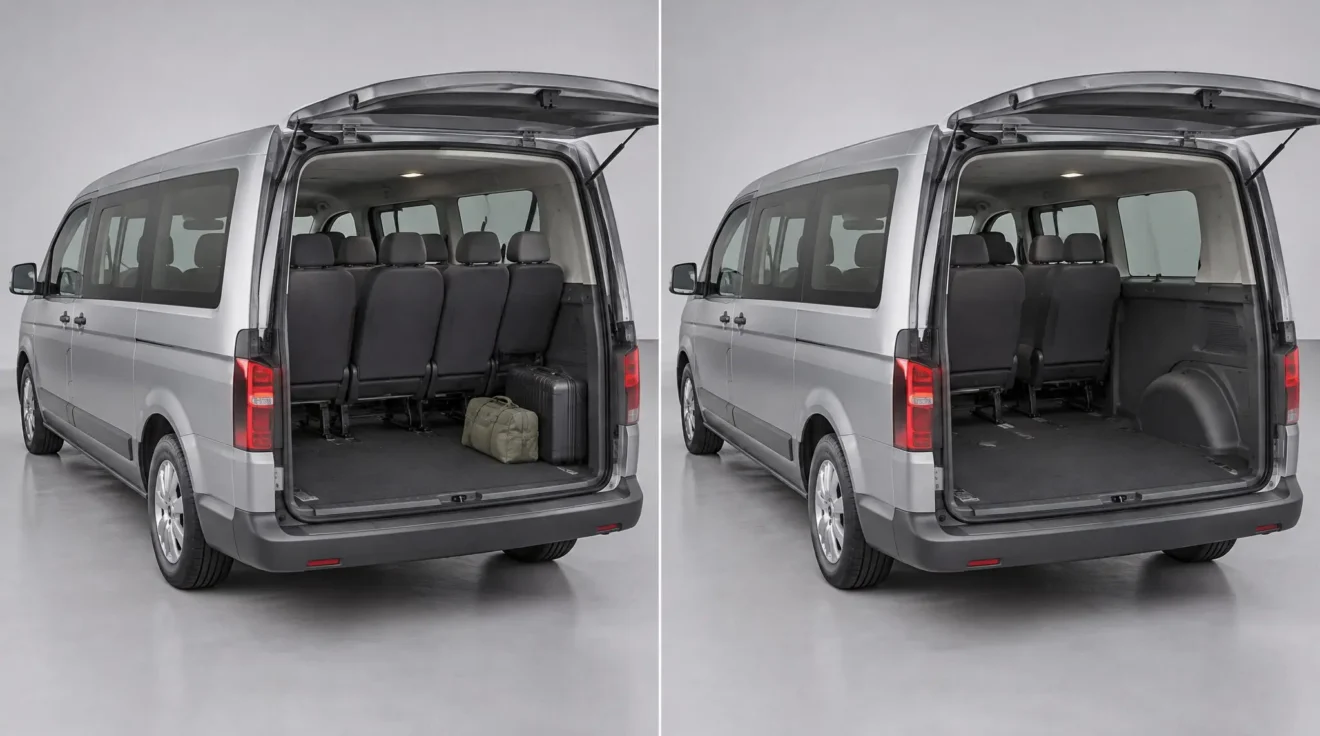
Passenger capacity alone does not determine how much storage remains behind the last row. Three characteristics are particularly important: body length, the position of the rear seats and the shape of the available luggage compartment.
A longer vehicle can provide additional rear storage without removing passenger seats, although the actual benefit depends on its interior layout. The depth and height of the compartment also matter. A tall suitcase may not fit beneath a rear window, while several rigid cases can be difficult to arrange when the available space has an irregular shape.
Manufacturer specifications illustrate why the exact configuration matters. In a release dated 18 March 2021, Renault stated that the New Trafic Combi and New SpaceClass could accommodate up to nine people with up to 1.8 m³ of trunk volume. This is a historical manufacturer maximum, not a measurement guaranteed for a vehicle currently supplied by a rental operator. The Renault’s historical trunk specification demonstrates that passenger capacity and substantial luggage space can coexist in a particular vehicle configuration.
A second example makes the seating distinction even clearer. Peugeot’s 2016 Traveller documentation specified 1,500 litres of boot space in its passenger configuration, with up to 4,900 litres available when removable seats were used to expand the cargo area. These figures describe different arrangements. The larger figure cannot be used to describe luggage capacity with all passenger seats occupied. The historical Peugeot’s Traveller specifications illustrate why seat removal and fully occupied passenger configurations must never be treated as equivalent.
For a group of nine occupants, including the driver, the relevant measurement is therefore the usable storage volume that remains with all required seats installed. A vehicle’s maximum cargo capacity in another configuration does not answer the airport luggage question.
Cabin bags versus large suitcases: what the luggage count really means
Counting bags is only the first step. Their external dimensions, shape and rigidity determine how efficiently they can be arranged inside a minibus.
Cabin bags are generally more compact and easier to position around other luggage. Medium suitcases require more floor space, while large checked cases can consume a substantial part of the rear compartment. Sports equipment, pushchairs and professional cases introduce another difficulty because their shapes may prevent otherwise possible stacking arrangements.
Consider two groups travelling with the same number of bags. One carries compact cabin luggage, while the other has large rigid suitcases. Although both groups report an identical item count, their storage requirements are not equivalent. This is why an advertised capacity of nine luggage units should not be interpreted as nine guaranteed large suitcases.
It is also important to consider how the luggage will be positioned. Rigid cases need a stable surface and sufficient clearance around their handles and wheels. Soft bags can sometimes occupy irregular gaps, but should not be relied upon to compensate for an undersized compartment. Heavy objects must be arranged securely rather than stacked in a way that could shift during travel.
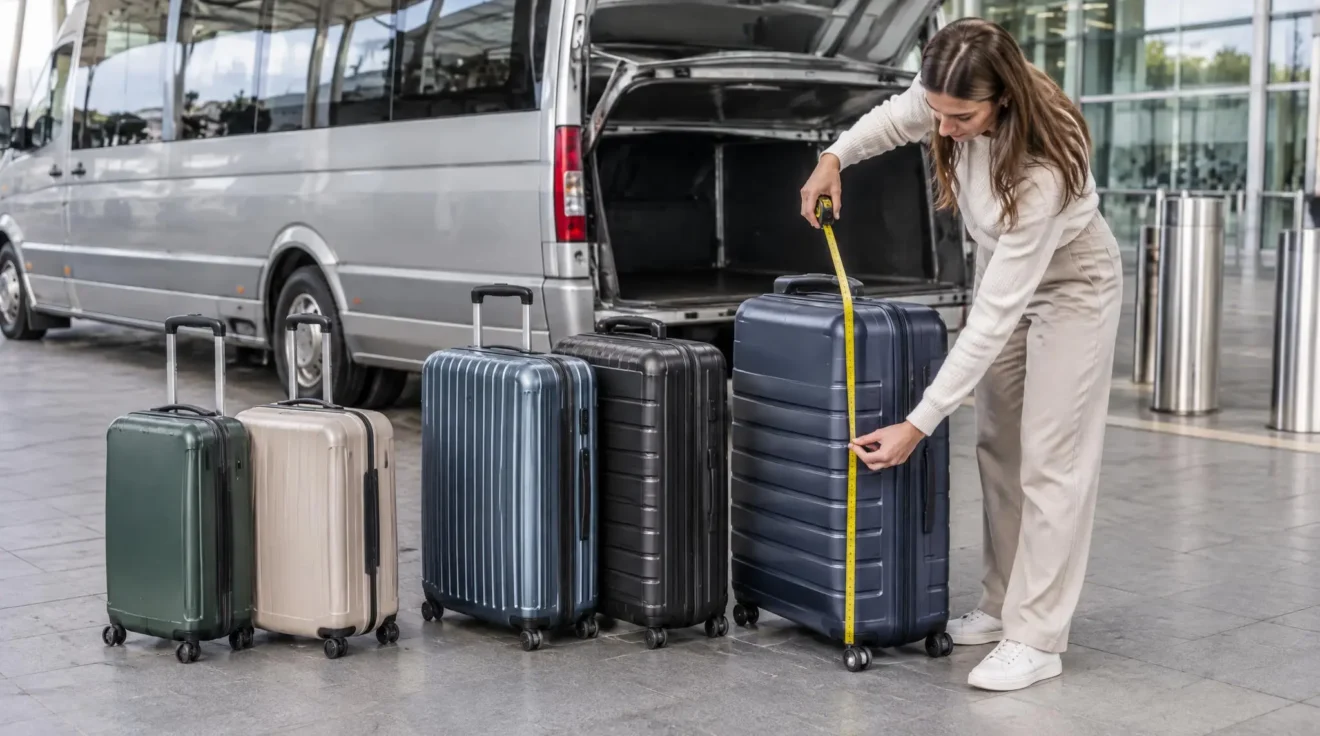
Before booking, prepare an inventory containing the number of cabin bags, medium suitcases, large cases and any unusual equipment. Measure the external height, width and depth of the largest items, including protruding handles and wheels. This information gives the rental operator a much clearer picture of the storage space required than a simple statement that the group has nine bags.
Important distinction: An advertised luggage count is not a standard suitcase-size guarantee. Confirm the external dimensions of your bags and ask whether they fit with all nine seats occupied.
How to confirm your luggage will fit before booking
A few precise questions can prevent a mismatch between the vehicle reserved and the luggage brought to the airport. The following checks are particularly useful when all nine seats, including the driver’s seat, are needed.
- Confirm the exact vehicle model and body length.
- Verify that all nine seats are available simultaneously.
- Count every cabin bag, suitcase and equipment case.
- Measure the external dimensions of the largest bags.
- Ask for luggage capacity with every seat occupied.
- Check whether the named model is guaranteed or subject to substitution.
- Request confirmation of the luggage arrangement before arrival.
It is worth asking specifically whether the advertised luggage capacity applies to the exact vehicle version being reserved. Two vehicles carrying the same model name may have different body lengths or interior configurations. If the operator can provide a photograph or technical dimensions of the rear compartment, these can also help assess whether particularly large or irregular bags will fit.
For travellers collecting a vehicle at Paris CDG, the published service information identifies the Paris-Nord (Roissy) agency and a meeting point in front of the Ibis hotel on rue de Bruxelles. The collection arrangements and applicable time should be confirmed against the actual reservation. Preparing the luggage inventory before arrival makes the vehicle-selection discussion more straightforward.
One final consideration is vehicle substitution. If the requested model is not guaranteed, ask whether an alternative will preserve both the required nine seats and the luggage space previously confirmed. A replacement with the same passenger capacity may not necessarily provide the same storage arrangement.
The most useful confirmation is specific rather than general. Instead of asking whether a nine-seat minibus has enough luggage space, provide the number and dimensions of the bags and ask whether they can all be accommodated with every passenger seat in use. This makes it possible to discuss the actual storage requirement rather than relying on an undefined luggage allowance.
A nine-seat minibus is suitable only when it can accommodate the entire group and its luggage at the same time. Treat the published luggage counts as an initial guide, not a guarantee for large suitcases. Before finalising the reservation, confirm that the exact vehicle configuration has all nine seats available and enough usable storage for the group’s measured bags, including any bulky equipment.